

Embodiment
Embodiment changes what you do when there’s no time to think, especially when no one is watching. It is the harmony between head and heart.

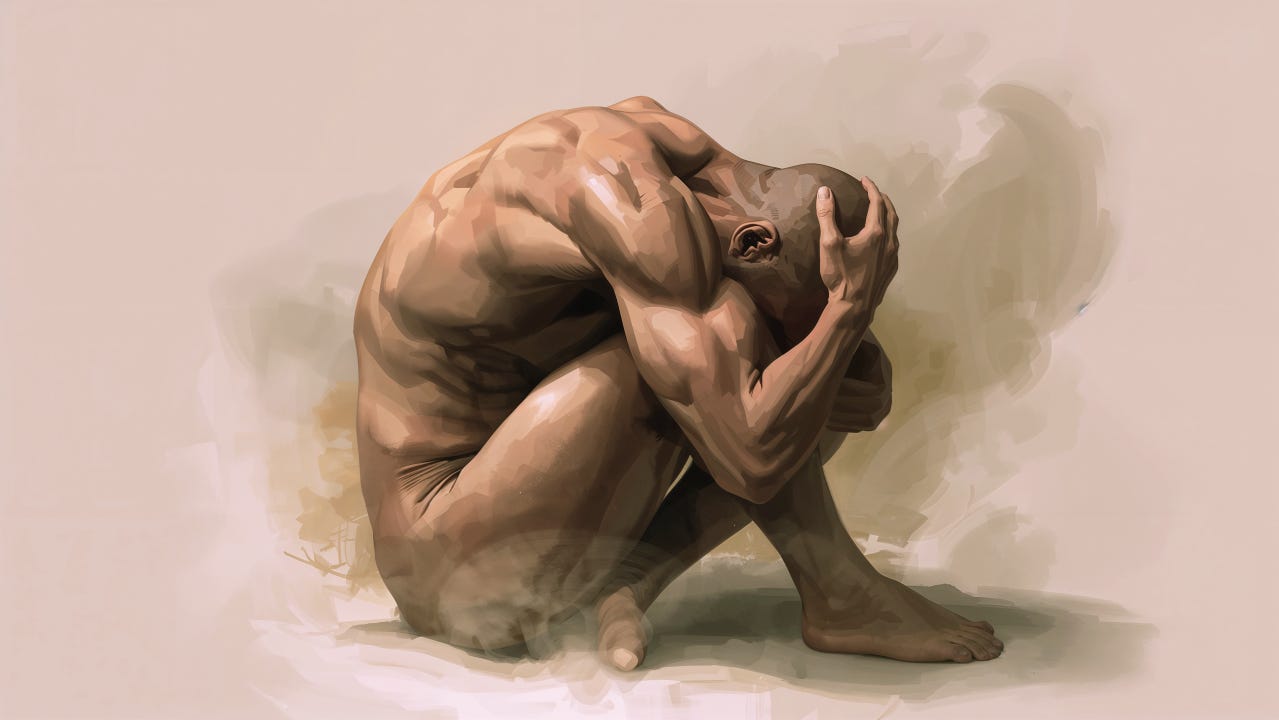
How to keep a promise your body can carry
We often confuse insight with change. An insight snaps something into focus and changes what you notice; you can’t unsee it. Understanding arranges it into a story you can explain. That can happen in ceremony, in meditation, in therapy, or in a hard hour with a therapist or coach.
This settles as new knowledge. We live in a time of surplus and radical accessibility in the form of books, articles, videos, podcasts, data, training, and practices. We know more, sooner, than any generation before us. And yet action stalls. We collect ideas, compare them and judge others against what we know and have come to believe, and get stuck in cognitive paralysis and indecision. Insight and knowledge feel good, and they can masquerade as progress.
Under pressure, behaviour doesn’t switch just because the mind has. The body responds and repeats what it has always done. Your phone lights up “urgent” and your chest tightens before thought arrives. You see it in moments with high stakes: an awkward meeting, a difficult conversation with a loved one, a tense text, a child asking for attention while your mind is elsewhere. The insight was true. It just didn’t hold when it mattered.
Some of us move from knowledge to wisdom and act from what now matters. That is a worthy and noble step. Yet there is more. For many of us, the step that turns good intention into reliable change is embodiment, akin to the integration of insight, knowledge, and wisdom.
Embodiment changes what you do when there’s no time to think, especially when no one is watching. It is the harmony between head and heart.
So how do we turn insight and knowledge into an action our body can carry?
What we mean, plainly
Insight is the perspective snap when a frame breaks and a hidden pattern shows itself. It is not a new fact so much as a change in what stands out. You only solve the puzzle when you allow yourself to draw outside the imagined border; the move is perceptual before it is verbal. Carl Jung pointed in this direction with individuation and active imagination, where insight serves integration rather than clever interpretation.
Knowledge is how we stabilise that snap into words and concepts. It is propositional, the things we can state as true. Useful, but thin on its own. To travel well and have a lasting impact, it needs know‑how (skills), situated sense (what matters here and now), and participation (who I am with this). Philosophers distinguish knowing‑that from knowing‑how. The philosopher Michael Polanyi reminds us we often know more than we can tell. For Polanyi, knowing isn’t just about facts and logic; it’s also about the unspoken, hard-to-explain feel we develop through doing and observing.
Wisdom is clear seeing plus proportionate action. Less self‑deception, more contact with reality. It is not about describing life better; it is about choosing better with fewer hidden costs. We recognise wisdom when priorities clarify and we act with proportion. Aristotle called this phronesis, practical judgement formed by habit; Buddhism names it prajña, direct seeing cultivated alongside ethics and concentration.
Embodiment is when practice reshapes perception and habit so the wise move happens before narration, especially under pressure, in breath, posture, timing and tone. A value is real when it reaches your breath and your actions and your way of showing up match. Daoists (Taoism) describe the end state as wu wei, effortless action in tune with the situation; and, in therapy or ritual, repeated practice and exposure make new responses reliable.
How it tends to flow
Insight becomes knowledge when the “aha” is put into language and shared. Knowledge becomes wisdom when we intertwine skill, perspective, and participation, and test it under a little friction. Wisdom becomes embodiment through repeated cues and constraints that teach the nervous system what to do next, so the response is reliable even when the gap between stimulus and response is small.
I’ve often asked myself why I stop short of embodiment, why the integration of medicine work, meditation, and many other modalities remains so difficult in making fundamental shifts, and how we may do better and become better.
I don’t think it's because we’re weak, but rather because we were trained to prize statements over practice. School rewarded correct answers, not the small habits of pausing and paying attention. Many families praised being agreeable more than holding a warm boundary. Work often prizes speed and certainty. And our nervous systems do what kept us safe before: please, perform, or push back.
What’s real is that under pressure, the nervous system prioritises speed. It pattern‑matches the moment to past moments and fires the response that has been reinforced, because that response reduced discomfort before. It’s less about belief and more about familiar wiring. Habits, conditioning, and learned “safety strategies” show up first.
A small biology note helps. Stress shifts the body toward protection: breath moves high into the chest, heart rate picks up, vision narrows. You don’t need to defeat this; you need to guide it so choice becomes possible again. Longer exhales or a few seconds of silence before you respond tell the body it is safe enough to choose, not just react. Eyes up to the horizon widen your field. Shoulders down, jaw soft, feet felt on the floor. These simple signals give your good ideas room to act. Watch anyone who does this, and you will find that they are inspiring, you are drawn to them and you feel safer. Try it for yourself. If you lose it, repair it quickly and simply. The apology matters less than the posture (tone) it rides on.
From the inside, embodiment is a moment of space before you speak, a steadier tone, and a choice that arrives without argument. Under the same pressure, you keep your footing and return to baseline sooner. Other people can feel it, the conversation settles, and the next right move is easier to see.
A friend asked, “What’s the KPI for embodiment?” A fair question. You’ll know it is taking root when the following quiet signals repeat. Under pressure, your body softens a notch. Breath lower, exhale a touch longer, shoulders down. The change is objectively visible, not just a feeling you have. Fewer interruptions. Steadier tone. Clearer boundaries. Quicker repairs. The room settles. People defend less and say more. Decisions take fewer rounds. Recovery is faster. The spike is smaller and you return to baseline in minutes rather than hours, with less rumination and more next right move(s). Other people often notice and feel this before you do.
Here are seven shifts I’ve documented that make this tangible, embodiment visible (and measurable).
1. Noise → signal. Regain focused clarity in a world of distraction and pull.
Proof: you switch tasks less, your calendar has protected focus blocks, and priorities look simpler.
Practice: before each task, take 90 seconds to breathe, name the single next step, and remove one distraction.
2. Reaction → response. Emotional fluency under pressure.
Proof: you pause, name what is present, and choose action over impulse; recovery after triggers is shorter.
Practice: quietly label the feeling, then take one tiny next step that serves the aim.
3. Drift → direction. Values‑aligned choices.
Proof: clearer yes or no, shorter decision loops, less second‑guessing.
Practice: before deciding, ask three questions: does it serve the aim, does it honour the people, can I stand by it next week?
4. Depletion → vitality. Steadier energy across the day.
Proof: more consistent sleep, planned micro‑breaks, fewer end‑of‑day crashes.
Practice: two daily micro‑rituals, a few minutes of morning sunlight and one phone‑free meal.
5. Performance → authenticity. Less masking, more honest contact.
Proof: cleaner boundaries, more honest asks, faster repair.
Practice: a two‑sentence truth check before hard conversations: “What I feel is…”, “What I’m asking is…”.
6. Bias → curiosity. Open mind, better judgement.
Proof: more questions than assumptions and the ability to steelman an opposing view.
Practice: in each meeting, ask one sincere question, reflect back what you heard, then add your view.
7. Self → stewardship. From me to we.
Proof: language shifts from “me” to “we”, visible care for people and place, others step up.
Practice: one weekly stewardship act, mentor someone, unblock a colleague, or improve a system.
In the practice for embodiment, think of these living on a spectrum, not binary. Choose one shift for a week until you notice that this is becoming second-nature. Learn, apply, integrate, repeat.
There will be friction. Old patterns are deep. Insight or knowledge alone will not rid you of them overnight. Over time, through embodiment, you will experience real change. This can be likened to vipassana. In vipassana, old habits, patterns and trauma are known as saṅkhāra. They are mental formations or conditioned tendencies from past experience that keep suffering alive. Think of them as karmic imprints: ingrained reactions or emotional residues held in mind and body. Through repeated practice of meditation, you work through them layer by layer, and new patterns and relationships become possible.
Many monks dedicate their lives to such practices. So you will slip and feel the old heat in your cheeks. Good. That is another opportunity to teach it. When it happens, name the smallest honest sentence you can say to yourself or to the other person: “I reacted fast”; “I want to slow down”. Over time, these micro‑corrections are how the body learns it can carry the promise. Keep it simple. Move a belief from statement to practice. Practice where it will actually be used. You will notice the line from your head to your heart gets straighter with use.
The promises we break most often are the ones we make to ourselves. We take an insight, turn it into knowledge, and call it growth. Sometimes we even wear the appearance of wisdom. But until that wisdom is integrated, until it is lived in the body, it remains unembodied, a shadow of the truth we long for.
If one moment this week arrives and your body keeps the promise before your mind remembers it, that is the shift. A promise is real when your body can keep it. Over time it becomes a presence that stays.
Follow Zenacious on LinkedIn
If you’ve made it this far, thank you. These are personal reflections—born from my own experiences, shared so others might relate. It’s a labor of love and growth. If it resonates, subscribing (it's free), liking and sharing means a lot. Please consider following me on LinkedIn.
● —aj. Warm heart, clear mind & strong spirit.
Asim! This specific space between knowing and being is so crucial to personal evolution.
What a lovely exploration of exactly what it means to move from the head to the body; from wisdom to embodiment!